






Something unprecedented has occurred at the pinnacle of this year’s QS Global 200 MBA rankings for North America – a three-way tie. Sure, the names involved – Harvard Business School, the Wharton School and Stanford GSB are arguably exactly the US business schools you’d expect to find in such a three-way tie, but it’s still a pretty rare occurrence in the world of MBA rankings.
The MBA rankings are based on the esteem in which the schools are held by two expert demographics: actively hiring MBA employers (85%) and academics in the field of business and management (15%). So, as far as these two groups are concerned, you can’t really go too far wrong with any of these three venerable US business schools.
But, of course, they are very different institutions, with their own unique selling points. So, what’s the difference? It’s impossible to present a perfect picture of an institution’s ‘fit’, but here are a few things that might be able to help you on your way.
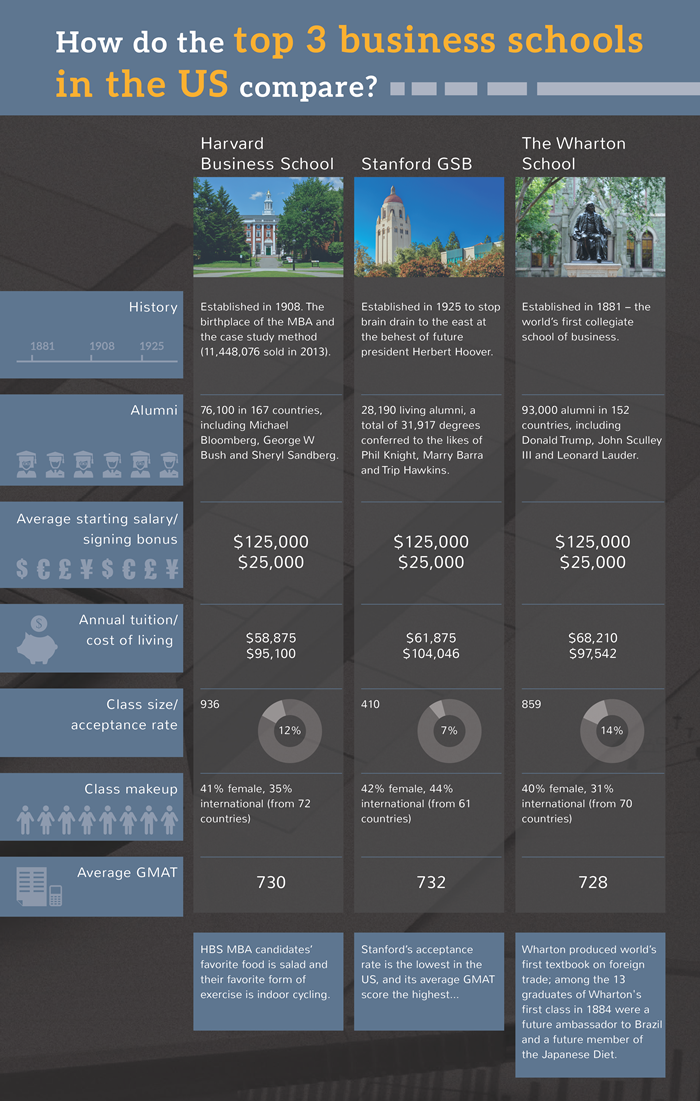
Short on time? Scroll down for our at a glance infographic...
History
Each of these US business schools has played a pivotal role in the history of the MBA. Wharton, founded in 1881 was the world’s first collegiate business school and publishers of the world’s first textbook on international trade, Harvard was the birthplace of the MBA and the case study method, and the foundation of Stanford GSB (at the behest of none other than future president Herbert Hoover) was part of a successful bid to stop a brain drain to the east coast – you’d be hard-pressed to identify such a brain drain today…
Who studies at HBS, Wharton and Stanford GSB?
As you might expect, you have to be quite special to even think about studying at one of these august US business schools. Stanford is one of the world’s most competitive institutions, with only the massively over-subscribed Indian IIMs really giving its 6.8% acceptance rate (to become one of the 410 students who make up the class of 2016) a run for its money.
Harvard’s class of 2016 comprises of 936 students; 12% of total applicants, while Wharton’s class of 859 represents 14% of the total applicants. Stanford also leads the way for gender parity, with females making up 42% of its class of 2016; HBS and Wharton are not too far behind on 41% and 40% respectively.
HBS’s class of 2016 is 27 years old on average, and hail from a total of 73 nations, the US accounting for 65% of students. Collectively the MBA cohort can count 282 alma maters between them, at which 41% studied economics or business, 40% STEM subjects, and 19% humanities and social sciences. The most common industry backgrounds are consulting (18%), venture capital/private equity (17%) and financial services (14%).
Wharton’s class of 2016 has an average work experience of five years, which would presumably put the average age in a similar ballpark to HBS. International students, from 70 countries, account for 31% of the class. At undergraduate level, 45% studied humanities/social science/economics, 27% business, and 23% STEM subjects (with 5% studying ‘other’ subjects). In terms of industry background, consulting again comes in at number one (20%), followed by government/military/nonprofit (13%). Private equity/venture capital is tied with consumer products/retail/health care/energy in third (12% each).
At Stanford, the equivalent MBA cohort has an average of four years of workplace experience. The class is more international than either of its eastern rivals, with 44% of students coming from outside the US, although they come from a smaller number of countries (62 – although, recall, there are far fewer of them). A total of 158 undergraduate institutions are represented, with humanities and social sciences accounting for 48% of the cohort, engineering, mathematics, or natural sciences for 28% and business for the remaining 14%.
Average GMAT scores for this elite trio range from 728 at Wharton, to 730 at HBS and 732 at Stanford GSB, so if you have designs of studying at one of these three…well, you’d better knuckle down.







Get closer to your dream programme
Your consent preferences have been set.
Time to start exploring.
Your account has been removed.
You can still browse the site or sign up again once you have parental consent.
Get closer to your dream programme