


Your input will help us improve your experience.
Your input will help us improve your experience.You can close this popup to continue using the website or choose an option below to register in or log in.
Already have an account? Sign in
Sign up free to keep exploring.
We use Necessary cookies to make our website work. We’d also like to set optional Functional cookies to gather anonymous site visitation data and Advertising cookies to help us understand which content our visitors value the most. By enabling these cookies, you can help us provide a better website for you. These will be set only if you accept.More information about the cookies we use can be found here Cookies Policy
Thanks for visiting TopUniversities.com today! So that we can show you the most relevant information, please select the option that most closely relates to you.
Views
Sustainability the Focus in New MBA Ranking Release
Save
Share
Share via
Share this Page12
Table of contents
Table of contents
Where should you study if you’re primarily concerned with sustainable business and in learning how consideration for social and environmental challenges can be integrated into management roles?
That’s the rationale behind the 2015 Better World MBA Ranking produced by media and research company, Corporate Knights, who have carried out similar assessments for more than a decade.
This latest installment concentrates on evaluating three aspects of institutions’ strength with regards to sustainable business: Students’ opportunities to get to grips with sustainability within the confines of an MBA program’s core curriculum, faculty expertise in the area and the number of associated research centers linked to a particular business school. The top 20 in the MBA ranking (from a total of 121 schools assessed) is as follows:
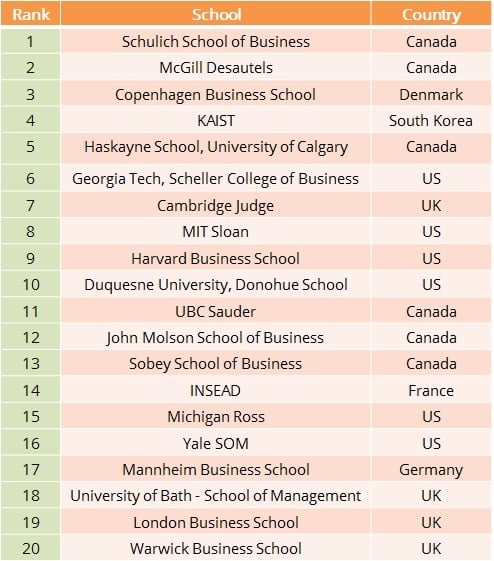
Top schools for a focus on sustainable business
Source: Corporate Knights
Business schools in the US and Canada – where this MBA ranking originates – make up 12 of the top 20, with two Canadian schools at the helm, Schulich School of Business and McGill Desautels and a third, Calgary’s Haskayne School of Business, also in the top 10.
Georgia Tech’s Scheller College of Business is the US’s top-ranking school here, in sixth place, although there’s also room for MIT Sloan, Harvard Business School and Duquesne University in the top 10.
Scheller sits one place ahead of Cambridge Judge - the UK’s top entrant and its sole top-10 member. However, Denmark’s Copenhagen Business School is Europe’s top-placing institution in this sustainable business reckoning (having been ranked 10th in Corporate Knights’ 2013 assessment). Finally, although it is Asia-Pacific’s solitary representative in the top 20, South Korea’s KAIST (formerly, the Korea Advanced Institute of Science and Technology) reaches the lofty rank of 4.
Schulich School of Business retains top spot
Schulich School of Business’ place at the top is no surprise – the Toronto-based school has spent 12 years at the top of Corporate Knights’ assessments. While admitting that assessing MBA programs along its ‘better world’ thinking is an “inexact science”, the ranking’s producers concluded that having five core courses, five research centers, and one well-cited academic research paper every three years for each faculty member all represented good targets to aim for based on the current status of the sustainable business field.
Top-ranking Schulich was said to have scored highly this year for having three MBA core courses with the requisite focus as well as over hundred faculty publications in the 2012-14 period analyzed and 15 relevant institutes and research centers. Cambridge Judge, meanwhile, drew praise for its alternative finance center, Yale SOM for its financial stability program and Copenhagen Business School for what is described as “an impressive ecosystem of institutes and centers.”
In helping to prepare graduates to tackle social and environmental challenges, Corporate Knights’ CEO, Toby Heaps, said that the top-ranking programs “serve a vital and growing demand for leaders who understand the interrelatedness between the planet, people and profits, and know how to harness the power of business for a better world.”
Tim is a writer with a background in consumer journalism and charity communications. He trained as a journalist in the UK and holds degrees in history (BA) and Latin American studies (MA).
Recommended Articles Last year
MBA After BA: Should I Do an…
MBA programmes accept an array of undergraduate students. Read our QS guide on how to pursue an MBA with a non-business graduate degree.
MBA accreditation: everythin…
When looking for the right MBA programme, accreditation is an important consideration. It allows students to understand the way their qualification will be seen by employers and how it can be compared to other highly-regarded programmes.
Where are Europe’s Top EMBA…
Find out which top business schools rank at the helm of the European leaderboard for EMBA programs. Meet with 70% of these schools one-on-one!