


Your input will help us improve your experience.
Your input will help us improve your experience.You can close this popup to continue using the website or choose an option below to register in or log in.
Already have an account? Sign in
Sign up free to keep exploring.
We use Necessary cookies to make our website work. We’d also like to set optional Functional cookies to gather anonymous site visitation data and Advertising cookies to help us understand which content our visitors value the most. By enabling these cookies, you can help us provide a better website for you. These will be set only if you accept.More information about the cookies we use can be found here Cookies Policy
Thanks for visiting TopUniversities.com today! So that we can show you the most relevant information, please select the option that most closely relates to you.
Views
MBA Salary: Expectations and Reality in 2015
Save
Share
Share via
Share this Page12
Table of contents
Table of contents
The very nature of researching the return on investment (ROI) of an MBA degree entails having a figure in mind for the MBA salary you hope to achieve on graduation.
While the monetary benefits of the qualification will play out over the long term as much as the short term, the initial post-MBA salary is, understandably, a clear point of interest when ascertaining its suitability to your individual goals.
So, how do the target MBA salaries of tomorrow’s MBA students match up to the reality found among graduates of the world’s top business schools?
Two annual pieces of research put together by the data geeks in the QS Intelligence Unit allow us to make such a comparison. The figures below detail the average current earnings and target MBA salaries of prospective MBA students responding to the QS TopMBA.com Applicant Survey 2015, by region, and the remuneration reality for MBA cohorts, as reported by their employers for the purposes of the QS TopMBA Jobs & Salary Trends Report 2014/15.
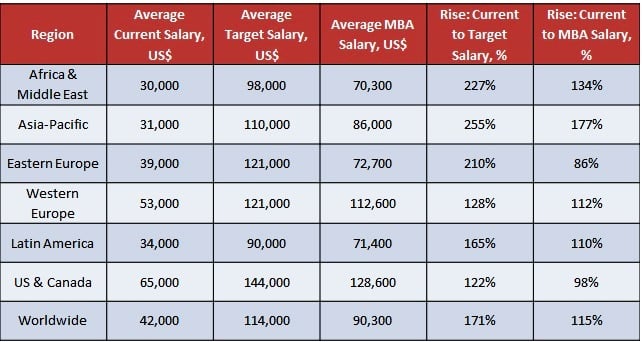
Comparing 2015’s target MBA salaries to those on offer in 2014
Sources: QS TopMBA.com Applicant Survey 2015 and QS TopMBA Jobs & Salary Trends Report 2014/15. Please note: actual salaries are total compensation figures and the worldwide figures represent merely the average of the regional averages and are given purely for illustrative purposes.
Of course, this comparison is by no means a perfect indicator of how MBA salary expectations measure up to the reality of just how deluded or overly-optimistic this year’s batch of MBA prospects might be.
First and foremost, it is based on the premise that graduates will seek an MBA salary in their home region – which we know to be far from certain, given the international mobility of both the MBA students and graduates of today. Secondly, the actual MBA salaries on offer will always vary quite widely across industries, limiting the accuracy of averages.
However, it is still a useful comparison to make because applicants’ expectations should be based on their understanding and knowledge of the MBA job market. These applicants aren’t exactly pre-experience kids without an inkling of the machinations of the employment market; these are high potential young professionals with a few years in industry already under their belts.
Renewed confidence among tomorrow’s MBA students?
Yes, the MBA salary expectations are higher than the reality in every region – but it’d be a bit strange if prospective MBA students were dreaming of packages that are lower than those already being given out in reality. Plus, these are students who won’t be graduating for at least the next year or so, and we did see salaries in the mature MBA job markets of North America and Western Europe rise in 2014, particularly in the US – where by most accounts a corner was turned in its economic recovery.
Looking back to previous years, we see that applicants’ expectations are up a fraction, from US$112k to US$114k. However, they are still lower than the equivalent figures of US$117k and US$126.5k in 2013 and 2012, respectively. With actual MBA salaries rising for the most part, it doesn’t seem perturbing that applicants’ expectations have also risen slightly. Indeed, applicants’ current earnings have also risen - from US$41k to US$42k – which might go some way towards explaining the renewed confidence in their earning ambitions here.
The long-term trend is therefore one of the gap between expectation and reality narrowing and if you look at individual regions, you can see that the figures point to a doubling in earnings in all but two regions, which is surely a decent return in the timeframe.
Tim is a writer with a background in consumer journalism and charity communications. He trained as a journalist in the UK and holds degrees in history (BA) and Latin American studies (MA).
Recommended Articles Last year
MBA After BA: Should I Do an…
MBA programmes accept an array of undergraduate students. Read our QS guide on how to pursue an MBA with a non-business graduate degree.
How to Pay For an MBA
Financing your MBA isn't easy, but with scholarships, fellowships, grants, and employer support, there are plenty of options out there.
Measure your MBA ROI
Business school is expensive, there’s no two ways about it. A simply MBA ROI calculation, however, will show you that it’s worth it…