






The QS Global MBA Rankings 2018 have now been released and represent the most comprehensive MBA ranking that QS has complied to date. We have been producing MBA rankings since the early 1990s, albeit in a pared-down single-indicator format (employability), before adding a second (academics) in recent years.
The QS Global Employer Survey and the QS Global Academic Survey are still used to determine a program’s ranking, this year attracting over 40,000 and 75,000 responses respectively, from employers and academics all over the globe. To these, we have added a wealth of data, drawn from verified school-provided statistics, an assessment of the academic affiliations of over 49,000 CEOs, executives, board members and entrepreneurs, and a calculation of the average return on investment enjoyed by graduates.
The end goal is a more robust ranking.
This data allowed us to assess schools across five key indicators, with various weightings, and has helped us to produce the most evolved rankings we have ever released. The key indicators and the weightings are: ‘Employability’ (40%), Entrepreneurship and Alumni Outcomes’ (15%), ‘Return on Investment’ (20%), ‘Thought Leadership’ (15%) and ‘Class & Faculty Diversity’ (10%).
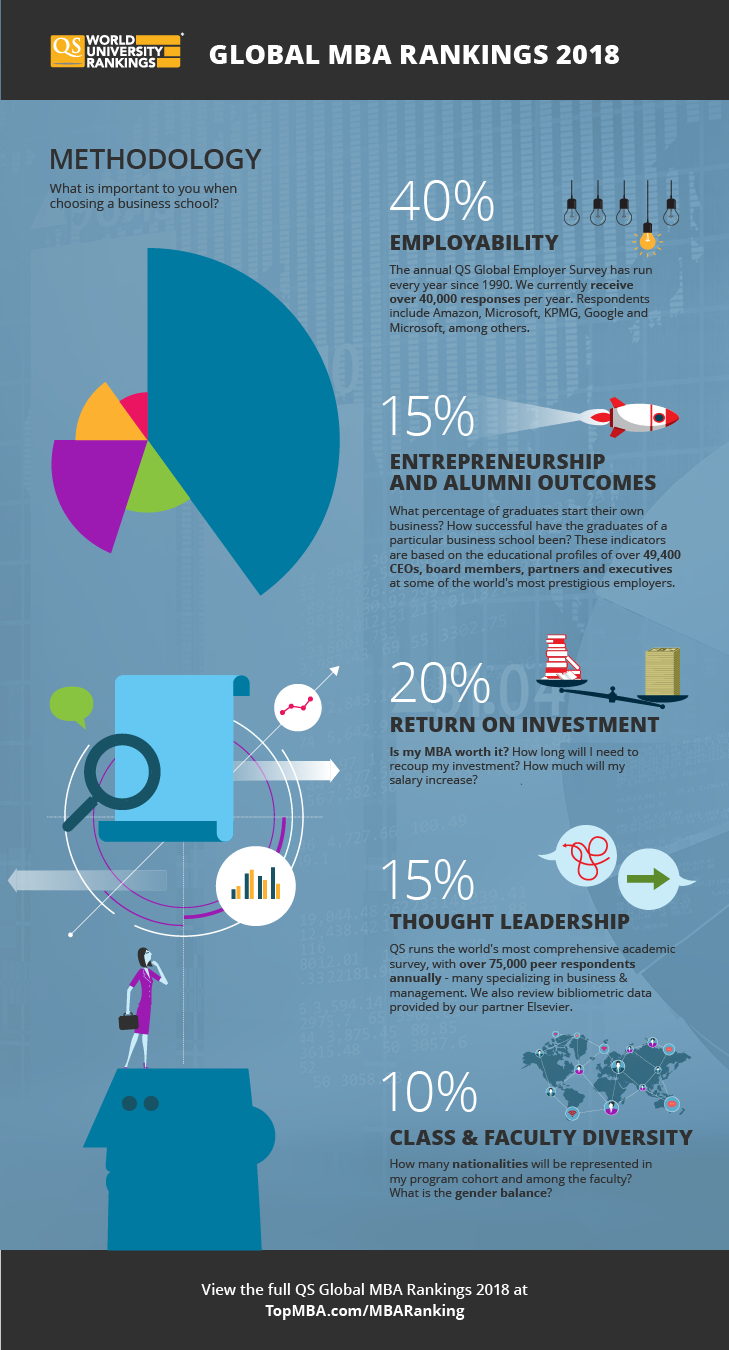
For more details on how we calculated the ranking of a program, take a look at our Global MBA Rankings 2018 Methodology.









Get closer to your dream programme
Your consent preferences have been set.
Time to start exploring.
Your account has been removed.
You can still browse the site or sign up again once you have parental consent.
Get closer to your dream programme